Green credentials in Indian hospitality have moved a long way from marketing language. What was once a collection of operational choices -- turning off lights, replacing plastic straws -- is now subject to formal third-party certification, institutional recognition, and increasingly, procurement criteria from corporate clients. For independent hotel owners, the distinction between these two levels matters more than most realise.
The gap is this: operational sustainability is what a GM decides. Formal certification is what an owner commits to. They are not the same thing, and confusing them is one reason many independent properties underinvest in the latter even when they have already done the harder work of the former.
What operational sustainability looks like in practice
At the operational level, sustainability in Indian hotels typically takes three forms. The first is waste reduction -- elimination of single-use plastics from guest rooms, food and beverage, and back-of-house. The second is energy and fleet management -- replacing diesel vehicles with electric alternatives, investing in solar infrastructure, and reducing overall consumption per occupied room. The third is supply chain localisation -- sourcing produce from nearby farms, reducing food miles, and in some cases maintaining an on-property organic kitchen garden.
These are genuine commitments. They carry real costs -- EV fleet maintenance, premium on certified local produce, training staff on new procedures -- and in cost-sensitive markets like industrial-corridor hotels and mid-scale properties, carrying them reflects a deliberate choice. The decision to sustain them through rate pressure is not trivial.
"My long-term objective is to make sure that my hotel is sustainable -- that it offers value for money for the customer as well as for us. It has to be win-win."
That framing -- sustainability as a condition of long-term viability, not a premium add-on -- is the operating philosophy that separates GMs who treat green initiatives as marketing from those who embed them in asset management. The quote above is from Vaishakh Surendran, reflecting on rate strategy at Mercure Chennai, Sriperumbudur -- a property that combined a full EV fleet, single-use plastic elimination, and an organic kitchen garden in one of India's most price-sensitive industrial corridors.
The IGBC layer: what formal certification means
Above the operational level sits formal certification. In India, the primary framework is the Indian Green Building Council (IGBC), affiliated with the Confederation of Indian Industry (CII). IGBC runs multiple rating systems adapted to building type -- Green Homes, Green Factory Buildings, Green Hospitals, and Green Hotels among them. For hospitality, the relevant programme covers both new construction and existing buildings, with assessment criteria spanning energy efficiency, water conservation, indoor air quality, materials, and site management.
Registration under IGBC is an owner-level decision, not an operational one. It requires committing the property to a formal assessment process, engaging with CII-appointed auditors, and in many cases investing in infrastructure upgrades that qualify the building for higher rating bands. The cost and time involved are real, which is why registration alone -- before any rating is awarded -- is recognised as a commitment signal.
CII designates properties that register under the Green Building Rating System as "IGBC Green Crusaders." The title is not a rating outcome; it is recognition of the decision to begin the formal process. On World Earth Day 2025, Lyfe Hotel Bhubaneswar (owned by Crackers India Infrastructure Ltd) received Green Crusader designation, having registered the property under IGBC. The engagement that led to that registration was led by Vaishakh Surendran as General Manager.
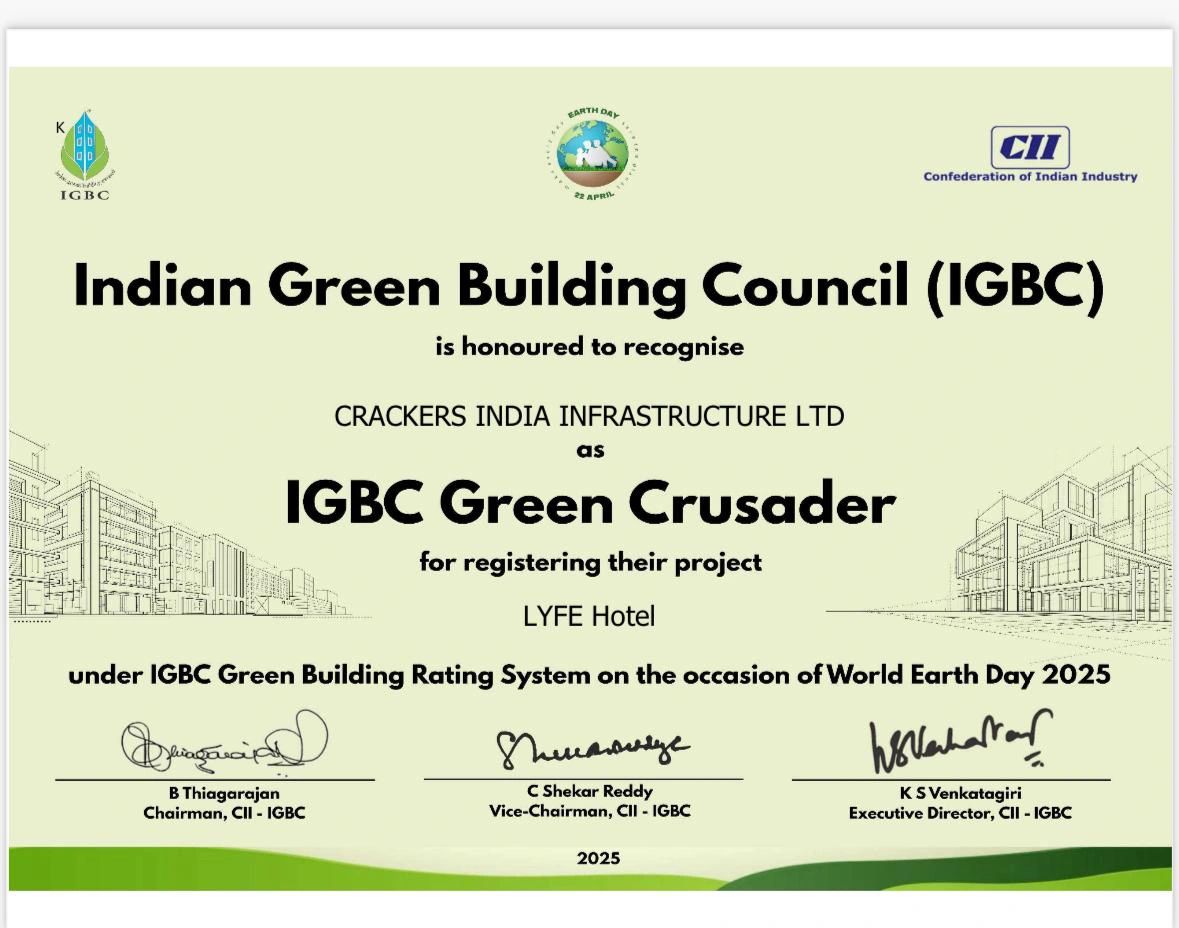
This matters for a specific reason: formal registration is not something a GM can initiate alone. It requires the owner's buy-in, financial commitment, and willingness to subject the asset to external assessment. Guiding an owner through that process -- explaining the long-term rationale, managing the registration, coordinating with CII -- is a different kind of work from operational decisions about which EV to lease.
Why owners should pay attention now
The case for formal certification has historically been made on brand grounds: a certified property can display the IGBC mark, differentiate in hotel comparison, and appeal to environmentally-conscious leisure travellers. That argument has always been weaker than its proponents claimed, because most guests do not filter by green certification.
The stronger case is in corporate procurement. India's manufacturing sector -- the primary demand driver for a large proportion of the country's mid-scale and upscale business hotels -- is under increasing ESG pressure from international clients, institutional investors, and SEBI's Business Responsibility and Sustainability Reporting (BRSR) framework, which became mandatory for the top 1,000 listed companies by market capitalisation from FY 2022-23. As large companies formalise their supply-chain sustainability reporting, the accommodation choices of travelling employees enter scope. A hotel with a verified green credential -- even at the registration level -- becomes a defensible vendor choice in a way that operational claims alone cannot replicate.
This is not hypothetical. It is the same dynamic that has driven LEED certification uptake among commercial office buildings in Indian cities: the credential becomes worth acquiring not because of direct guest preference but because of how it functions in procurement and investor reporting chains.
For independent hotel owners considering where to direct capital and management attention in the medium term, formal certification is moving from optional to expected in the corporate segment. The gap between owning a sustainably-run property and owning a certified one is narrowing in importance -- and the time to register is before that gap drives a procurement decision.
Published by Veritas Hospitality Advisors, October 2026. All views are those of the advisory practice based on direct engagement with the Indian hospitality market.